Borders to me are about immigration. And with a grandmother that entered England from Romania in 1890 as a refugee, borders are also an emotional story.
In Canada, we have an agreement with the US that a refugee that first seeks asylum in the US cannot then try to gain entry to Canada. And it works the other way around as well. The refugees are just turned back at the borders.
So most refugees try to enter Canada by just walking across at some unofficial entry point, usually into the hands of the RCMP. They then go through a legal process and are given temporary living quarters.
Canadians are for the mostpart generous and sympathetic to the plight of refugees. Most of these illegal border crossings are in Quebec and Manitoba.
Most Canadians know we have a Canada-US border that is about 5,500 miles long. And something like 400,000 people cross the border each day. And a more amazing number is that about $2 billion in goods and services also cross the border each day.
In terms of borders, there is nothing like it anywhere in the world. And it is not all about straight lines like the 49th parallel. There is something like 900 different jigs and jags along the Canada-US border.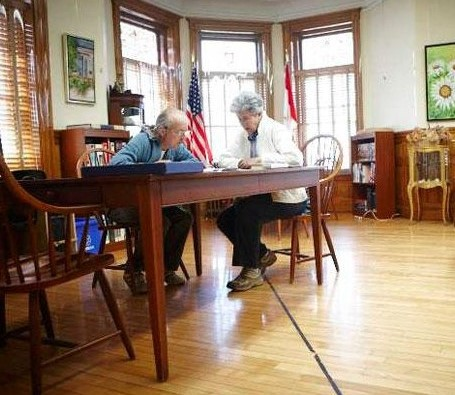 Love the story of the town of Stanstead in Quebec and Derby Line in Vermont. The US border goes right through the town. The joke is that in one home you can cook your meal in Canada and eat it in the US. There is a line (as shown in the photo) representing the border that runs through the local library.
I had an interesting border story to deal with back in the 1980s. My secretary at the Canadian Federation of Independent Business smoked a pack of cigarettes a day and told me she was offered illegal cigarettes for half the normal price at a local convenience store. As a spokesman for small business, I could smell a nasty news story.
When I talked to my contacts at what is now called the Canada Revenue Agency, they told me that convenience stores were a minor issue. Most illegal sales of cigarettes are made from the trunks of cars. The source at the time was the Akwesasne Mohawk Reserve near Cornwall where US cigarettes were smuggled across the border and sold to non-native distributors. It was not illegal to sell contraband cigarettes to other native Indians.
According to my CRA source, the federal government and provinces lose about $2 billion a year in taxes because of the sale of contraband cigarettes.
So I guess the big issue associated with the massive Canada-US border is not asylum seekers, but smuggling. And smuggling is a very profitable two-way business. We buy American guns and cigarettes, and Americans buy Canadian marijuana. With the legalization of marijuana in Canada, it looks like our country is going to be a global production powerhouse.
02-01 Issues
(blank) » John Bulloch » 10 Canada-US Relations » 02 Borders »